Santa Catarina Nursery Whale Heritage Area
Information
Description
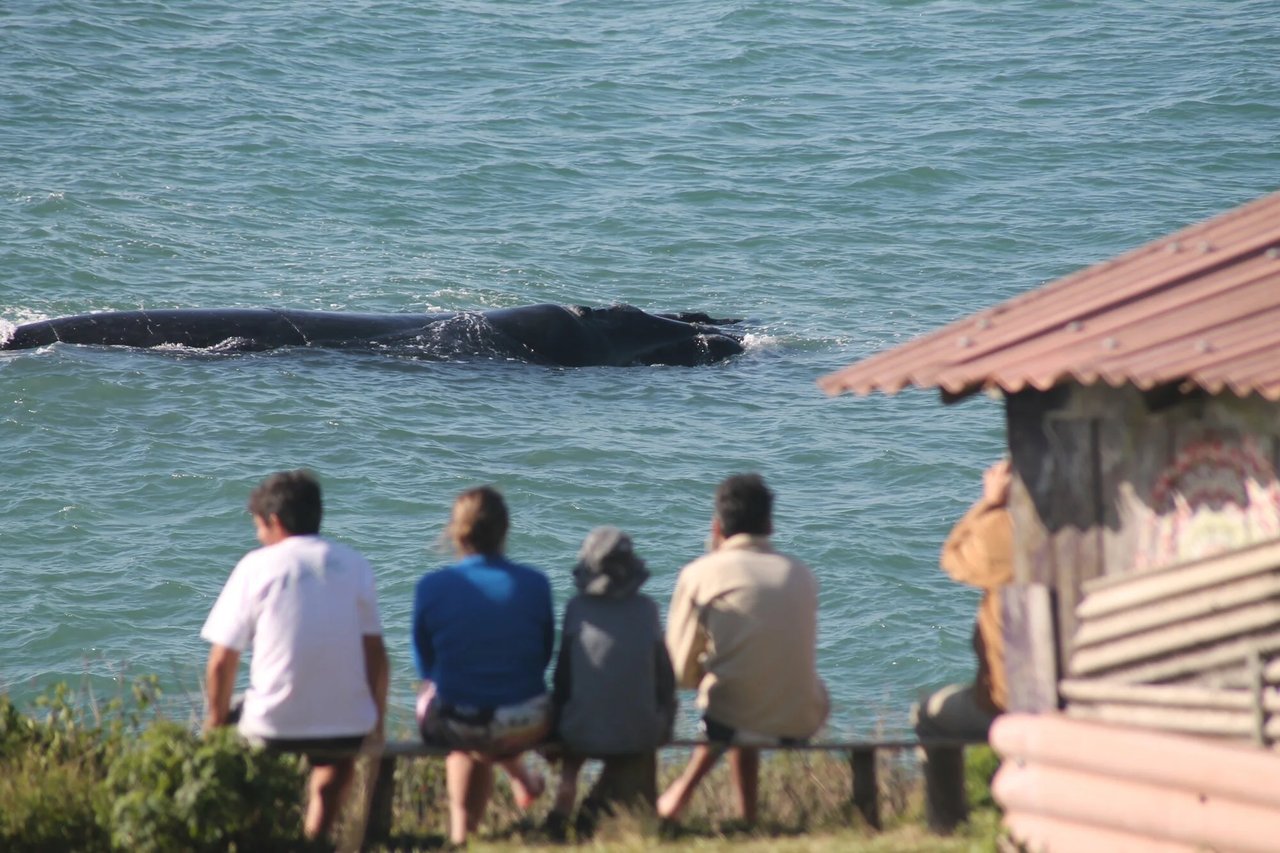
The Santa Catarina Nursery is an enchanting place where, every year from July to November, Southern right whales seek refuge in the small, shallow coves and warm waters to give birth and nurse their young. As the animals are very close to the coast, they offer an unforgettable opportunity to connect with nature for locals and visitors, who have the privilege of watching the mother whales interact with their calves from the beaches, shore, and dunes. The right whales’ preferred nursery area stretches along the municipalities of the central-south coast of Santa Catarina, starting in the central-north with the capital Florianópolis, passing through Palhoça, Paulo Lopes, Garopaba, Imbituba and Laguna (further south).
Most of the nursery is located within the Right Whale Environmental Protection Area (APA BF). This region has a wide variety of attractions for sports and nature lovers, as well as a rich historical and cultural heritage, making it an ideal destination for visitors to enjoy ecotourism and community-based tourism (CBT) experiences.
Right whales, which used to be hunted off the coast of Santa Catarina, are now a source of pride for the local population. It is a paradise for land-based whale watching and, through the TOBTerra Network, other organisations and whale watchers use the natural coastline for observation, as well as a lookout point on Gamboa beach, one of the nursery coves where the mothers and calves stay the longest. Many tourists and researchers alike walk the trails to spot the whales.
Motivation
The Whale Heritage Area initiative could support the Santa Catarina nursery in becoming a protected sanctuary. Being designated would bring greater recognition to the area, inspire communities and tourists to value these incredible cetaceans more, and result in stronger conservation measures to preserve this species and protect the ecosystems, with greater political and institutional engagement. This process would also support community-based tourism, which promotes the participation of the local community, and help to strengthen local links between responsible tourism, economy and quality of life.
Boundary map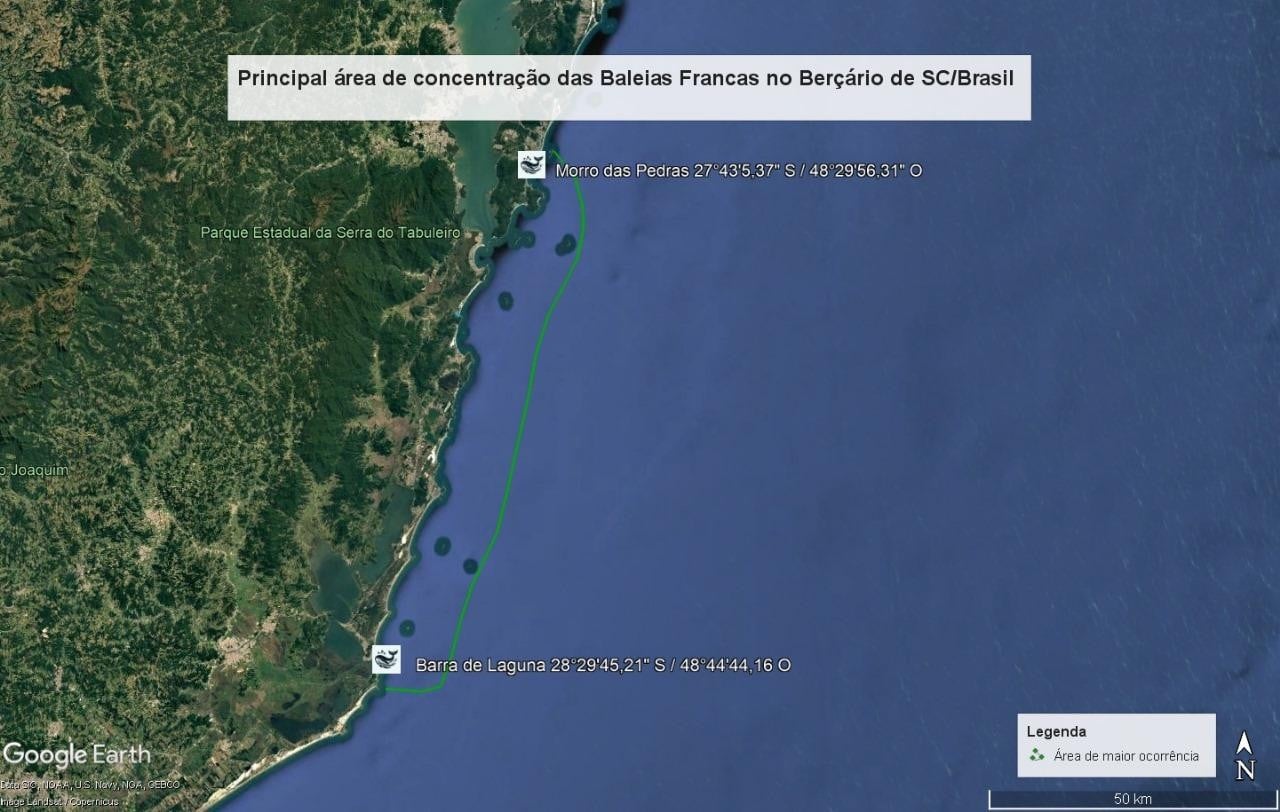
Species or habitats
The region is home to Southern right whales, which migrate from their feeding grounds in the South Georgia Islands to the southern part of Santa Catarina every year and stay in these protected coves between May and November for their breeding season.
In Laguna, there is also a group of resident bottle-nosed dolphins that live their entire lifespans within the local area, to the point of having their own culture, social rules and unique vocalisations. These dolphins interact closely with the local fishermen, helping them by signalling the location of shoals and pushing the fish towards their nets. This unique, collaborative relationship has become a tourist attraction.
Overview
Title: Santa Catarina Nursery Whale Heritage Area
Level: Designated
Name/location: Santa Catarina Nursery
Name/species/group: Whale
Country: Brazil
Area features
Southern right whale and bottlenose dolphins (resident population in Laguna)
Stability
The population of whales that visit the nursery area in Santa Catarina varies every year and, according to research, they have maintained a number of around a hundred animals. Some years, only a few dozen animals are recorded, and in other years a hundred or a little more are recorded.
Threats
In addition to the right whales being endangered, the coastal ecosystems, as well as the cultural identities and traditions of the local communities of artisanal fishermen, farmers, quilombolas, indigenous people and artisans who live in the territory, are also threatened by environmental degradation, unsustainable tourism and excessive property speculation, among other human actions.
Specifically, whales are also threatened by noise pollution, collisions with vessels, harassment from motorised vehicles such as helicopters and jet skis, water contamination and pollution, entanglement in fishing gear, and development of the coastal landscape and excessive artificial light.
Actions taken for protection
To protect the right whales from boat-based threats, the ban on motorised boats for whale watching has been maintained, especially in the nursery areas, and ensuring that operators respect the regulations in place regarding approaching whales and whale watching practices. Awareness campaigns, public policies, and strict enforcement will also be needed to minimise the threats of harassment from motorised vehicles, entanglement from irresponsible fishing, and pollution from improper waste disposal.
Community importance
Having a right whale nursery area raises awareness of environmental preservation and its importance for our wellbeing.
Watching right whales with their calves in the nursery area awakens feelings of connection with nature, boosting emotional wellbeing and health.
Wildlife watching guidelines
The presidential decree of 14 SEPTEMBER 2000 stipulates the creation of the Right Whale Environmental Protection Area (APA), located in the coastal region of Santa Catarina, with the aim of preserving the Southern right whale (Eubalaena australis), regulating various activities.
Observation guidelines:
- Respect the areas closed to boat-based observation in the Right Whale APA (see maps next to the text of the IN);
- Respect the boat approaching distances (switch off or put the engines in neutral at 100m).
- Never move sharply in the direction of the whales;
- Never approach from behind the whales or intercept their course, stay off to the side;
- Do not separate groups of whales or mothers from their calves;
- Never restart the engines without clearly sighting the animals on the surface;
- Do not make unnecessary noises or throw any objects into the water;
- Do not stay near the whales for more than 30 minutes;
- Never swim towards the whales, there is a high risk of accidents;
- Do not fly over the whales with any aircraft at an altitude of less than 100m above sea level.
- Boat-based whale watching tourism is prohibited.
Criteria
1. Cultural importance of wildlife
- Cultural heritage linking people and cetaceans. Whaling history. (PDF)
- Whaling engravings (jpg)
- Whale museum (PDF)
- Cultural connection with whales through music (PDF)
- Whaling history (jpg)
- Whaling history (jpg)
- Local participation in the planning of the Welcome to the Whales Festival. (jpg)
- Local participation in the planning of the Welcome to the Whales Festival. (jpg)
- “Jardineiras del Mar” transcript - Interactions between whales and society (txt)
- “Jardineiras del Mar” transcript - Interactions between whales and society. Continuation. (txt)
- “Jardineiras del Mar” transcript - Interactions between whales and society. Final. (txt)
- Fisherman ‘Vato’ - Testimony. (txt)
- Fisherman ‘Vato’ - Testimony. Continuation. (txt)
- Fisherman ‘Vato’ - Testimony. Final. (txt)
- Whale mural (jpg)
- Welcome to the Whales annual festival (jpg)
- Welcome to the Whales annual festival (jpg)
- Welcome to the Whales annual festival (jpg)
- Welcome to the Whales annual festival (jpg)
- Welcome to the Whales annual festival (jpg)
- Welcome to the Whales annual festival (jpg)
- Welcome to the Whales annual festival (jpg)
- Welcome to the Whales annual festival (jpg)
- Imbituba Right whale season celebration (PDF)
- Ocean and whales photo exhibition (PDF)
- Study and international collaboration on "Where whales are born" project (PDF)
- Cultural characterisation - APA Right Whale Environmental Protection Area Management Plan (PDF)
- Whale museum and visitor centre (PDF)
2. Respectful human-wildlife coexistence
- APA - Right Whale Environmental Protected Area (PDF)
- Management Plan - APA Right Whale Environmental Protected Area (PDF)
- Map zoning - APA Right Whale Environmental Protected Area (png)
- National Law that protects cetaceans and prohibits fishing or any form of intentional disturbance (PDF)
- REMAB - Brazilian Stranding Network (PDF)
- Franca Austral Project - ProFRANCA (PDF)
- Locals campaigning to protect right whales and the nursery (jpg)
- Bioconsciencia - The environment and education (PDF)
- Environment Week - The ocean and whales (jpg)
- Education and raising awareness about cetaceans at event (jpg)
- Education and raising awareness about cetaceans at event (jpg)
- Education and raising awareness about cetaceans at event (jpg)
- Education and raising awareness about marine life at event (jpg)
- Environmental education (jpg)
- Scientific research and collaborations (PDF)
- Mostra Lutz - Citizen science and environmental education project (PDF)
- Port of Imbituba-procedure for vessels to prevent collisions with whales (PDF)
- Dialogue, collaboration and mediation with community groups (PDF)
- Waste management information for exhibitors in the Whale Festival (PDF)
- World Ocean Day – Action for Biodiversity and Climate (PDF)
- ECOSURF - Independent Brazilian organisation that has been working to defend a healthy ocean (PDF)
- Beach clean-up event (jpg)
- Beach clean-up event (jpg)
- Waste station at event (jpg)
- Environmental impact education at event (jpg)
- Mural - Preserve Nature (jpg)
- Monitoring right whales - ProFRANCA (PDF)
- Following whales - ProFRANCA and the Aqualie Institute (PDF)
- Scientific flyover - Right whales records (PDF)


3. Responsible wildlife tourism
- Suspension of boat-based whale watching tourism - Sea Shepherd Brasil (PDF)
- Campaign to raise awareness about the threats of boat-based whale watching (jpg)
- Leaflets to raise awareness about wild cetacean tourism (jpg)
- Rede TOBTerra description (PDF)
- Promotion of land-based whale watching and eco-cultural tourism - TOB TERRA / COSTA CATARINA (jpg)
- Promotion of land-based whale watching and eco-cultural tourism - TOB TERRA / COSTA CATARINA (jpg)
- Promotion of land-based whale watching and eco-cultural tourism - TOB TERRA / COSTA CATARINA (jpg)
- Characterisation of ecotourism - APA Right Whale Environmental Protection Area (PDF)
- Decree which establishes specific regulations for interactions with cetaceans (PDF)
- Good practice manual for interacting with cetaceans (PDF)
- Guidelines for interactions with whales (PDF)
- Enforcement of responsible interactions with whales (PDF)
- Enforcement of National law that prohibits intentional disturbance of cetaceans (PDF)
- IBAMA - Responsible interactions with whales (PDF)
- TOB TERRA posters (jpg)
- Characterisation of ecotourism - APA Right Whale Environmental Protection Area (PDF)
- International dialogue roundtable (PDF)
- Tourism Characterisation - APA Right Whale Environmental Protection Area (PDF)
- Development of whale watching in Southern Brazil: conservation implications for right whales (PDF)


4. Steering committee
- WhaleHA steering committee members in OKUN (jpg)
- WhaleHA steering committee members (jpg)
- With Luizinho, a fourth generation native fisherman, now a member of the steering committee (jpg)
- Steering Committee (SC) with the secretary of tourism of Garopaba (jpg)
- SC with president of the chamber of inns / hotels of Garopaba and associated scientific researchers (jpg)